
On the ninth of July, Meta released a near-frontier AI model priced at a fraction of the going rate. Muse Spark 1.1 sells inference. Inference is the work a model does every time someone types a question and the answer appears on screen. Meta's price for it is $1.25 per million input tokens and $4.25 per million output tokens. Anthropic charges roughly $5 / $25 for Opus 4.8; OpenAI charges $5 / $30 for its flagship GPT-5.6 Sol. On input, that is about a quarter of the frontier price. On output, under a fifth. Cheap enough to raise the obvious question: why give away the margin on a model that cost billions to train?
Meta's own margin is not the point. The target is the margin OpenAI and Anthropic earn on every token they sell, the money that funds their next models.
A Price of Its Own
Meta arrived here the hard way. Llama 4 shipped with missteps in 2025 and stopped competing at the frontier. Meta went quiet for the better part of a year, rebuilt the effort around Meta Superintelligence Labs, and restarted the line with Muse Spark, now Muse Spark 1.1. The rebuild also changed the business model. Llama was open-weight: anyone could download and serve it, so a crowd of competing hosts set its price, not Meta. A price you do not control cannot be aimed at anyone. Muse Spark is closed from its first release. Closed weights make Meta the only seller, and the only seller chooses the price.
Meta's own framing puts the model exactly where the labs earn: agentic work, tool use, coding. From Meta's blog:
Whether the discount matters is the buyer's call. If OpenAI's and Anthropic's models are the only ones that can finish your work, you pay their price. If Muse Spark can finish most of the same work at a quarter of it, it earns a consideration.
The benchmark profile (Figure 1) says it can do much of it. On the public agent evaluations, the tests of tool use and multi-step workflows, Muse Spark 1.1 runs level with or ahead of the frontier. On raw coding it trails the leaders, and the gap is widest on long-horizon work. That gap matters less than it looks, because not every task needs the frontier. A large share of coding, tool-use and computer-use work is routine, and near-frontier capability finishes it just as well. Those are the tasks where a quarter of the price starts winning enterprise spend.
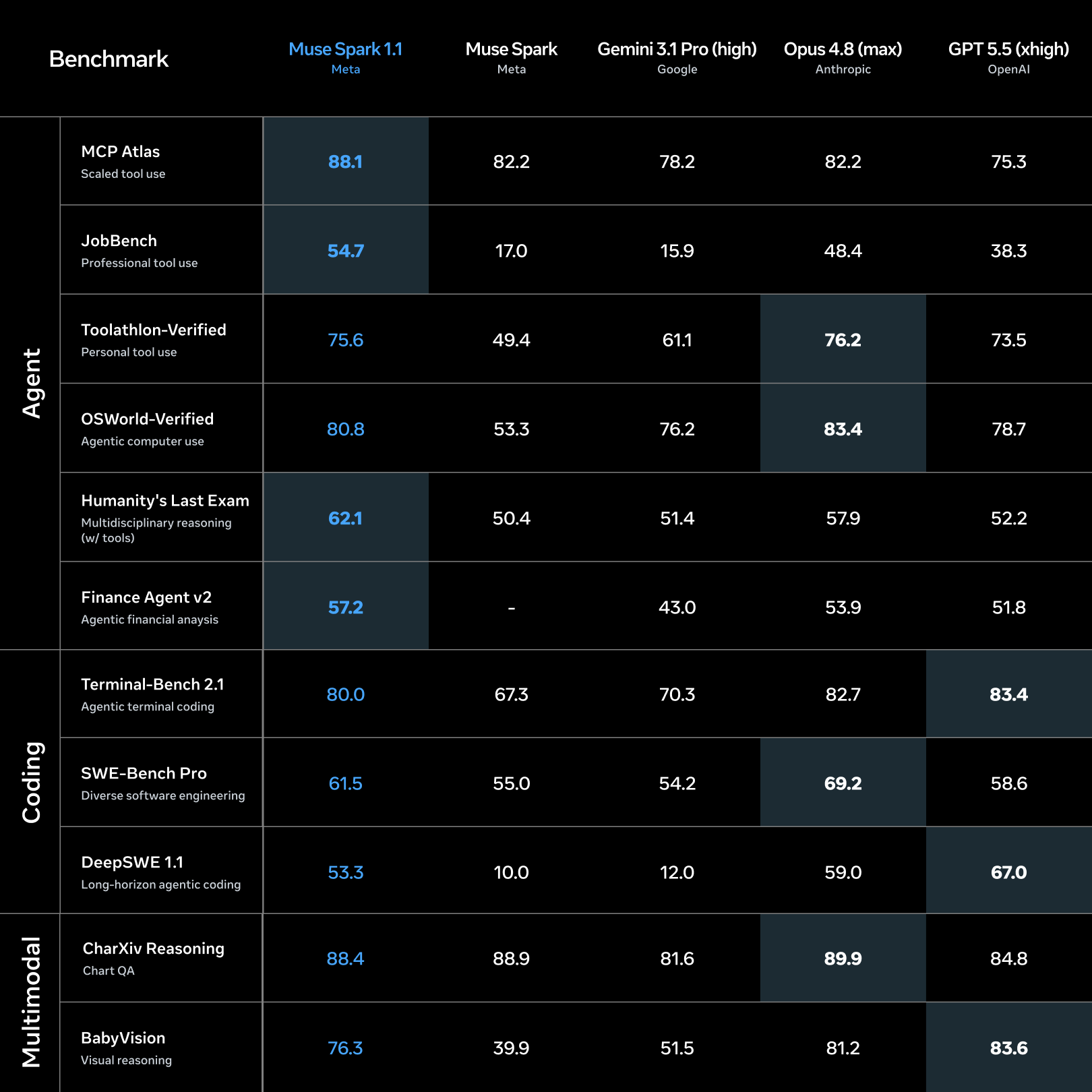
Figure 1: Muse Spark 1.1 versus the frontier across agent, coding and multimodal benchmarks
Zuckerberg has framed the price as deliberately aggressive.
The Margin War
The frontier labs are racing toward recursive self-improvement, where each model helps build the next one faster and a lead can compound beyond catching. Margin is the fuel for that race. Profit lets a lab raise at a higher valuation; the raise buys the next cluster; the cluster trains the next model; the model widens the lead. With no cheap alternative on the market, OpenAI and Anthropic can hold prices high and keep that flywheel turning.
Meta is attacking the first link. It can go years without earning a margin of its own, because its bills are paid by the Family of Apps advertising business behind Facebook, Instagram and WhatsApp; what it needs is for OpenAI and Anthropic to be starved of their inference margins. Put those margins under pressure and the flywheel slows; the prize is time for Meta Superintelligence Labs to reach the frontier.
Meta does not need a runaway lead to be certain, only possible. If recursive self-improvement arrives while Meta is behind, it is locked out of the most important market in its history, for good. Against that downside, the discount looks less like a price war than an insurance premium, paid on tokens Meta was going to serve anyway.
When the first Muse Spark shipped in April, we called it a play for attention rather than revenue. From The Mercurial Muse:
The price it now carries reveals the second edge of the same blade. A model that does not have to earn its own keep can be sold at any price Meta likes, including one no pure-play lab can live on. In April, indifference to model revenue built a better ad engine; in July, the same indifference sets the market price.
A sustainable price has to clear the seller's variable cost: the cost of serving one more token, not the sunk billions behind the model. That number differs for Meta and Anthropic because they are in different businesses. Meta throws off roughly $50 billion a year in advertising free cash flow, $12.4 billion in the first quarter of 2026 alone on $55 billion of quarterly ad revenue, and until this month it earned almost nothing selling AI. It can price at the floor and lose nothing it was counting on.
Anthropic cannot. The inference dollar is its entire top line: a revenue run-rate (the current pace of sales scaled to a full year) reported at $47 billion in May 2026 and estimated near $69 billion by mid-July. Almost all of it is Claude subscriptions and API access. The company's first quarterly operating profit is projected at around $559 million. The price leaves Meta indifferent. For a pure-play lab, it forces a hard choice: match it and surrender the margin that funds the next training run, or hold the line while a credible near-frontier model sits at a quarter of the price.
And that $559 million, the number Anthropic most needs to grow, is barely one percent of a single quarter of Meta's ad revenue. It is Jeff Bezos' old saying, your margin is my opportunity, at full force. Meta's version reads: your margin is your runway, and I intend to shorten it.
The Market's Answer
OpenAI moved the same day Muse Spark 1.1 shipped. That is the tell of a real contest, not a lone gesture. The answer was a ladder. GPT-5.6 arrived in three tiers: Sol at the frontier at $5 / $30, Terra in the middle at $2.5 / $15, and Luna at the floor at $1 / $6. Luna undercuts Muse Spark outright.
Anthropic sits at the other exit, and it was standing there before Muse Spark arrived. It holds the top of the Artificial Analysis Intelligence Index with Claude Fable 5, several points clear of the field, priced at $10 / $50, a premium above its own Opus 4.8. A lab that owns the hardest-to-copy frontier does not fight at the floor. It climbs and sells the one capability nobody else can match. Two exits: OpenAI down to meet Meta where the volume is, Anthropic up into the premium.
The attack even pays for itself on the way in, because before it sold a single Muse Spark token Meta was one of the labs' larger customers. An internal memo to six thousand employees warned that Meta's own AI bill was heading toward billions of dollars a year. Its engineers burned 73.7 trillion tokens in one month. Staff tracked the spend on an internal leaderboard nicknamed "Claudeonomics". The company has since banned Claude Code and OpenAI's Codex internally, and is likely to route that work to its own models over time. Muse Spark will not replace all of that spend. The share that does not need frontier capability, work the labs currently serve at hefty margins, is the share it starts to chip away.
Uber tells the same story from the buyer's side, burning through its entire $3.4 billion annual AI budget in four months before capping spend. The labs' revenue is the exact expense every enterprise that consumes AI is racing to cut, and cheap tokens cut it. At a quarter of the frontier price, the same budget buys several times the work, and AI projects that could not pay for themselves at frontier prices start to clear the bar. Buyers who see that return build more, not less. Every new workload routed through Muse Spark is volume for Meta and revenue denied to the labs.
Does the Weapon Work?
It might not. The labs are not funded by today's margin. They are funded by capital markets, and those markets are already deep in this race. In the same few weeks that Meta opened this front, SpaceX raised $75 billion in the largest IPO on record and Alphabet raised $80 billion to fund its AI build-out. Capital on that scale is available, but it is not unconditional.
That is exactly where the pressure lands. OpenAI and Anthropic are expected to seek public listings of their own, and the valuations they command will rest on revenue growth and a path to profitability. A price war threatens both. Cheaper rivals slow revenue growth. Matching their prices puts pressure on profits. A lab that cannot show growth and profits may have to delay its IPO or raise at a lower valuation. A smaller raise feeds straight back into the flywheel: less capital, fewer chips, slower progress toward recursive self-improvement, more time for everyone behind to close the gap. That is the game.
If you allocate capital, the open question is the durability of the model layer as a business, and lab gross margin is the leading indicator. A layer under permanent price pressure from a company that does not need the revenue is a harder place to earn a return than it looked a year ago.
If you build, Meta's strategy is already yours to use. Route the work you can verify cheaply, the tickets and tests and well-specified tasks, to the floor of the ladder. Pay for the frontier only where judgment and long-horizon reliability earn the premium.
The war for time is Meta's. The cheap tokens it produced are everyone's.