The Environment Gradient: Structured to Chaos
Deploying robots is a gradient of environment predictability. From highly structured factories to the chaos of the home.
As environment predictability drops, task variety and object variance explode, turning a simple robotic grasp into an unsolved reasoning problem.
Structured & Repetitive: the industrial floor
Industrial environments are designed for automation. Conveyors place parts in exact, coordinate-mapped trays, lighting is constant, and safety cages keep humans out. This high structure allows robots to run 24/7 without cognitive reasoning.
This is where robotic unit economics are most validated today: high repeatability, low variance, and easily checked outcomes.
Semi-Structured: the retail and service space
Retail service robots (like ice cream kiosks or ticket dispensers) work in public spaces. Tasks are constrained—dispense a cup, tap a screen—but the system must handle the high variance of human behavior: children reaching into the kiosk, unexpected obstacles, and unstructured speech.
The goal is defined, but the path requires active visual tracking, compliance loops, and real-time obstacle avoidance.
Unstructured: the domestic home
The home is the ultimate, most difficult frontier for physical AI. Work is intermittent, task variety is infinite (washing dishes, folded laundry, walking pets), and object variance is massive (unwashed pans, toys on the floor, varying furniture layouts).
Worse, reward functions are delayed or unverified: did the robot clean the kitchen correctly, or did it wipe grease across the counter? Building generalist home robots requires solving zero-shot visual planning and extreme compliance control.
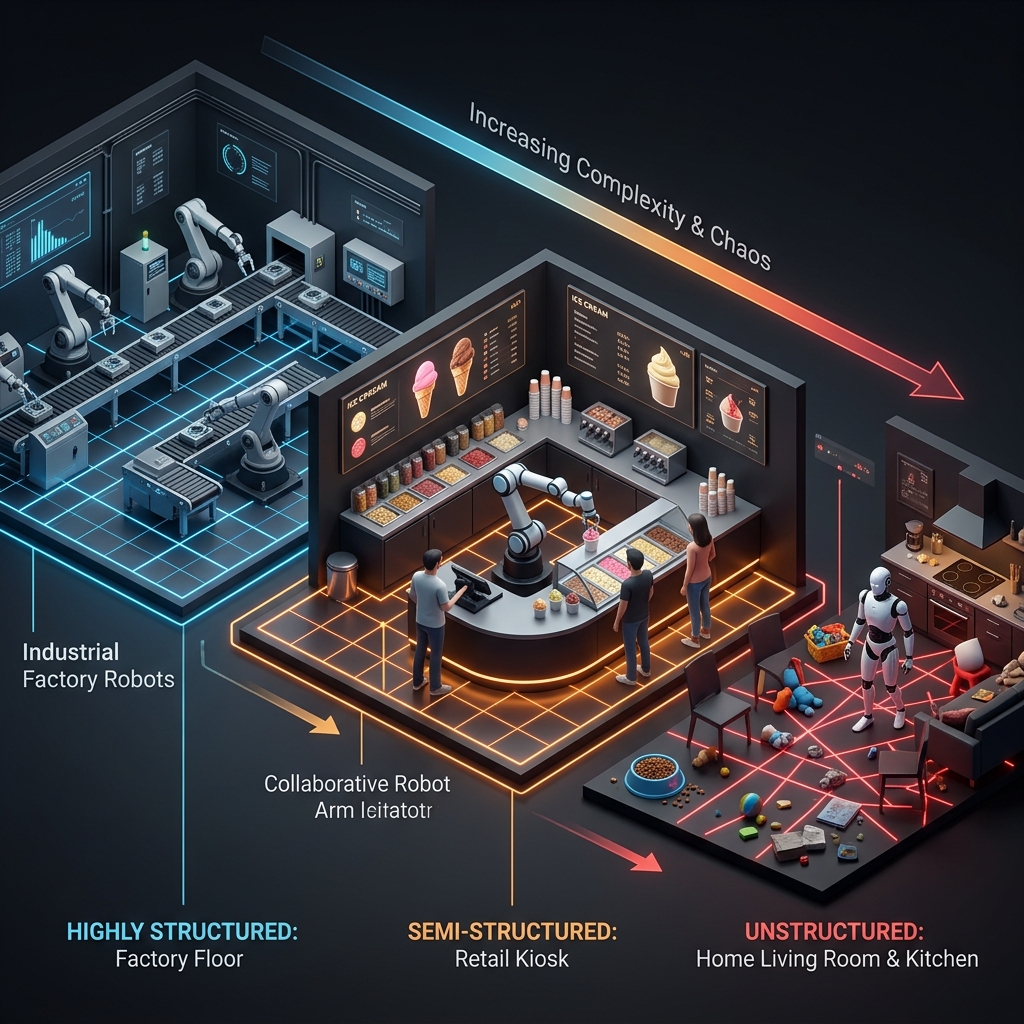
Gradient axis: Structured factories (left, coordinate-mapped, safe) to retail spaces (center, interactive, constrained) to home chaos (right, infinite variety).